Pea protein has become common enough in pet food that most formulators aren't asking whether to use it. They're asking how to use it well.
That's a harder question than it sounds.
Pea protein behaves differently depending on the format it's going into, and it's often working alongside pea starch and pea fiber, not as a stand-alone ingredient. Here's what it actually contributes in a pet food matrix, how that changes between kibble and wet food.
WHAT PEA PROTEIN ACTUALLY DOES IN A PET FOOD FORMULA
Pea protein's most obvious job is raising protein content without relying on additional animal protein. But in a working formula, it's doing more than that.
Pea protein has functional water-holding and emulsification properties of its own, which help it integrate into a formula rather than sitting inert alongside other ingredients. Its fine particle size also matters more than formulators sometimes expect: A consistent particle profile means the protein incorporates evenly across a batch instead of clumping or settling out during mixing, which becomes a bigger issue at commercial scale than it is at bench scale.
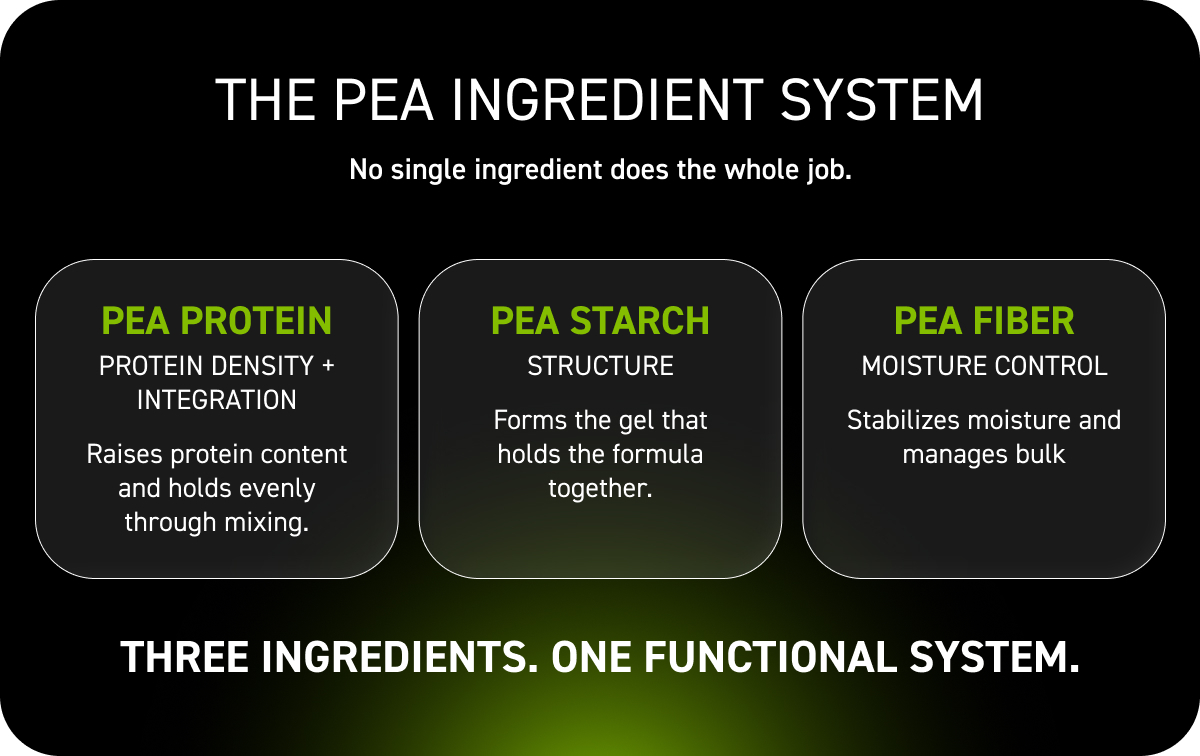
Pea protein rarely works alone, though. In most pet food matrices, it's paired with pea starch, which provides the primary binding and gel structure, and pea fiber, which manages moisture and bulk. Understanding pea protein in isolation only tells part of the formulation story. The functional system is protein for nutrition and integration, starch for structure, and fiber for moisture control.
KIBBLE VS. WET FOOD: WHY FORMAT CHANGES THE FUNCTIONAL DEMANDS
The same ingredient family behaves differently depending on what's being manufactured, and the manufacturing process is the reason why.
Kibble goes through extrusion, which applies heat, pressure, and shear all at once. In that environment, pea starch is doing the heavy lifting: It needs to gelatinize cleanly to support expansion and deliver the firm, crunchy texture kibble is judged on. Pea protein contributes protein density and a fine, consistent particle size that holds up through the extruder without breaking down unevenly.
Wet food and fresh food formats face a different set of demands. Instead of expansion under heat and shear, the ingredient system needs to form a retort-stable gel that survives thermal processing and still holds together as a cohesive loaf or a glossy gravy. Pea fiber becomes more important here, since it stabilizes moisture in high-meat or high-fat formulas that would otherwise separate.
Treats sit somewhere in between, depending on whether the format is crunchy, chewy, or semi-moist, and the ingredient ratios shift accordingly.
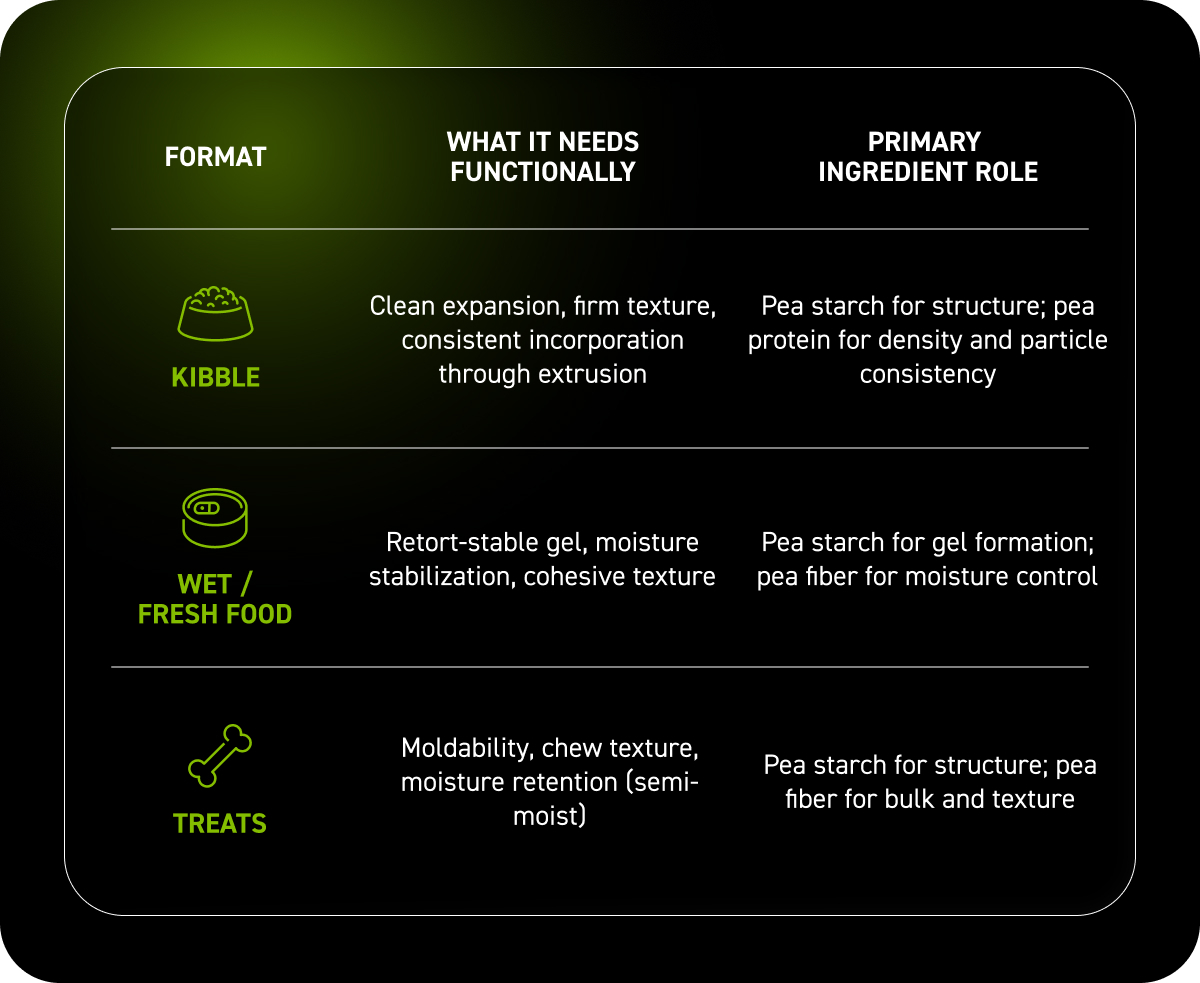
A formulator moving a formula from one format to another can't assume the same ratios will carry over. What worked in kibble often needs to be rebuilt for wet food, not adjusted.
DIGESTIBILITY, PALATABILITY, AND THE DCM QUESTION
Any conversation about plant protein in pet food eventually reaches two questions: Does the dog digest it well, and is it safe?
On digestibility, pea protein provides a complete amino acid profile for dogs, but like most plant proteins, it's naturally lower in sulfur-containing amino acids such as methionine. That's a known, manageable formulation variable, not a disqualifying one. Formulators typically address it by pairing pea protein with a complementary protein source or through targeted supplementation, the same way any single-source protein gets balanced in a complete diet.
On safety, it's worth addressing the DCM question directly instead of talking around it. The FDA opened an investigation in 2018 after receiving reports of dilated cardiomyopathy in dogs eating certain diets, a large share of which were grain-free and contained peas or lentils. In its most recent public update, the FDA has been clear that adverse event reports alone don't establish causation, and that no causal link between any specific ingredient and DCM has been confirmed. Testing on flagged products didn't turn up abnormalities in taurine or other nutrients that would explain the cases. The agency has said it won't issue further updates until there's meaningful new science to report.
That doesn't mean the question is closed. Researchers are still investigating why an association shows up in the data, with recent work looking at a potential metabolic mechanism rather than a straightforward nutrient deficiency. This is an active area of veterinary research, and it deserves a formulator's attention, not a dismissal. If you're sourcing pea protein for a pet food application, ask your supplier directly about their own testing data and how their ingredients are documented overall nutritional adequacy. A supplier with nothing to show you here is a bigger red flag than the open question itself.
WHAT TO LOOK FOR IN A PEA PROTEIN SUPPLIER
Given how much of this comes down to sourcing and testing, the supplier relationship matters as much as the ingredient spec sheet.
Look for documented, batch-level testing, not just a certificate of analysis that repeats the same numbers every time. Ask how consistent particle size and protein content are from lot to lot, since a formula tuned around one batch's functional profile can fail in the next if the supplier's process isn't controlled end to end. And ask where the peas actually come from. A supplier that controls the process from seed through processing can trace an issue back to its source in a way that one buying from a broad, mixed supply chain can't.

PURIS's OP870 family is built for exactly this kind of scrutiny: organic, non-GMO pea protein processed at our own facilities, with the traceability that comes from working with 400-plus contracted growers PURIS knows by name. That's the difference between a supplier that can tell you what's in the bag and one that can tell you where it came from.
FREQUENTLY ASKED QUESTIONS
Why is pea protein in dog food?
Pea protein is a plant-based protein isolated from yellow peas, used in dog food to increase protein content and support the ingredient's functional performance in the formula. It's typically used alongside pea starch and pea fiber, which handle structure and moisture rather than protein content.
Is pea protein bad for dogs?
Current research hasn't established that pea protein itself is harmful to dogs. The FDA has investigated a possible association between grain-free, legume-heavy diets and a heart condition called DCM, but has not confirmed a causal link, and testing has not found nutrient deficiencies in flagged products. Research into the underlying mechanism is ongoing.
Is pea protein safe for cats?
Pea protein is used in some cat food formulations for the same functional and nutritional reasons it's used in dog food. As with dogs, formulators should balance the amino acid profile for the species' specific requirements and work with a supplier that provides documented testing data.
How does pea protein's amino acid profile compare to animal protein?
Pea protein provides a complete amino acid profile but is naturally lower in sulfur-containing amino acids like methionine, similar to most single-source plant proteins. Formulators typically balance this through complementary protein sources or supplementation.
THE BOTTOM LINE
Pea protein isn't a single-purpose ingredient formulators can drop into any pet food format and expect the same result. What it contributes, and what it needs to be paired with, changes based on whether you're building kibble, wet food, or a treat.

If you're formulating with pea protein and want a supplier who can show you the testing and sourcing data behind it, that's a conversation worth having early.