How starch shapes expansion, density and texture in extruded snacks, and when a different starch system is worth a look.
The crunch isn't accidental
The moment someone bites into a puff, a lot of decisions come due at once. How airy it feels. How quickly it gives way. Whether it holds together until the last handful.
Most of those outcomes trace back to structure, and in a direct-expanded snack, much of that structure starts with starch. Yet starch is often the least-questioned line on a snack spec. It came with the original formula, it runs, and nobody wants to be the one who changed it.
That also means many teams never find out what a different starch system could do for their snack.
What happens inside the extruder
Inside the barrel, heat, moisture and shear turn starch granules into a stretchy, viscous melt. As that melt reaches the die, it's under pressure and well above the boiling point of water.
Then it exits. Pressure drops instantly, water flashes to steam, and bubbles grow inside the melt. The piece expands. Now the matrix has to set before those cells shrink.
What you get depends on how well the melt stretches and how strong the cell walls are when they set. Formula, moisture, temperature, screw speed and die design all play a part, and starch is one of the biggest levers.
Why starch selection matters
Starch is made of two molecules: amylose, which is mostly linear, and amylopectin, which is highly branched. Their balance changes how a starch behaves under heat and shear, and how the finished piece eats.
In an expanded snack, starch influences:
- Expansion: how far the melt stretches before it sets
- Density: how much air each piece holds
- Cell structure: pore size and wall thickness
- Texture: crispness and how the piece fractures
- Process: how the melt responds to moisture, temperature and screw speed
- The eating experience: the first bite and the crunch
What pea starch brings to the formula
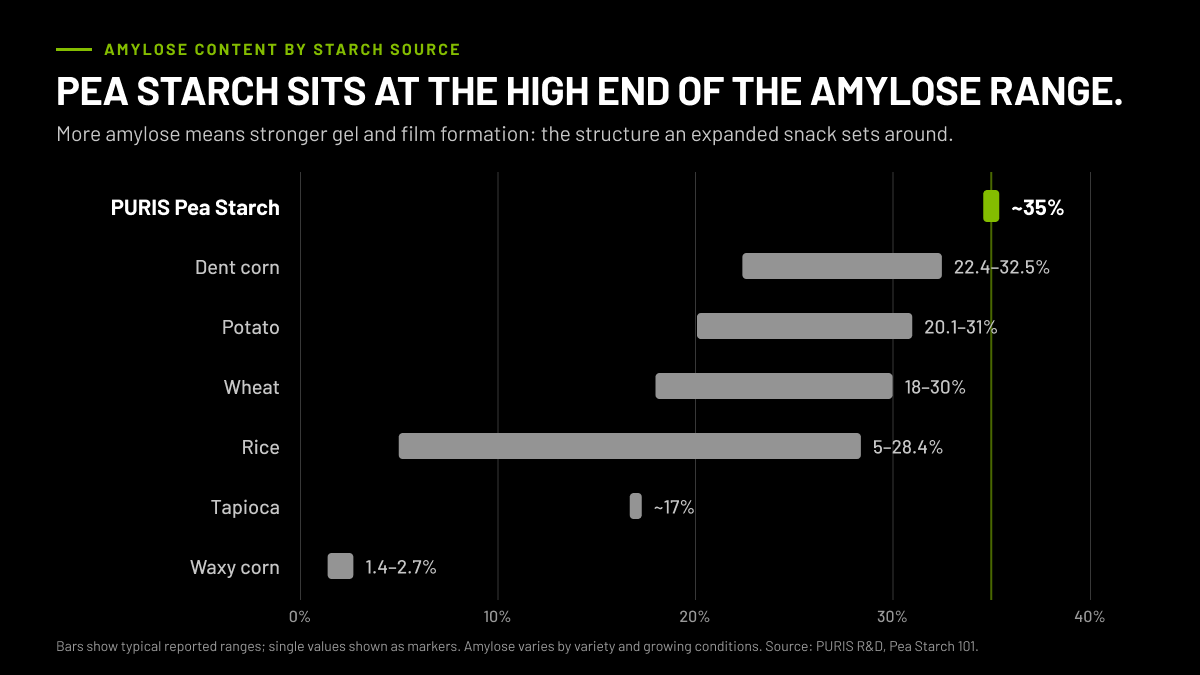
Pea starch sits at the high end of the amylose range for common native starches, at about 35%. That gives it strong gel and film-forming behavior, which supports the structure an expanded snack depends on.
It's also grain-free by nature, bright white, and made in the USA from North American grown peas, with both conventional and certified organic options.
The research backs it up, and it was done with our starch. In a peer-reviewed study published this year in Food and Bioprocess Technology, a University of Minnesota team led by Dr. George Annor blended PURIS pea starch into whole-grain Kernza® flour. Kernza is a perennial grain with about 20% protein and 20% fiber, leaving too little starch to puff well; on its own, it extruded into "dense, dark, compact, and minimally expanded" pieces. Adding PURIS pea starch changed that. Across 27 extrusion runs, the blends produced light, expanded ready-to-eat snacks with expansion ratios up to 2.16 and bulk density as low as 0.13 g/cm³. Pieces got less hard as more pea starch went in, and the brightest pieces came from the highest pea starch levels. In other words, pea starch did exactly what a snack developer needs it to do: give a hard-to-puff formula the structure behind the crunch.1
What we found when we tested pea in a puff
Our R&D team ran an extrusion study in a starch puff formulation, comparing PURIS Pea Starch with tapioca, corn, waxy corn and rice starches. In that system:
- Pea and tapioca showed no major processing differences.
- Pea and tapioca delivered similar piece expansion and density.
- Both outperformed corn and rice starch on expansion and density.
In short, pea starch performed comparably to tapioca in the puff system we tested. Every line is different, so the best next step is a side-by-side in your own system.
When pea starch is worth a look
Pea starch is a strong candidate when you:
- rely on imported tapioca and want a North American alternative;
- are building gluten-free or grain-free puffs and curls;
- are developing an organic snack and want an organic starch with a stronger sourcing story;
- work with a flour, grit or pulse base that pea starch can blend into.
For organic and sustainability-led brands, there's one more reason. PURIS Organic Pea Starch is made in the USA from North American grown organic yellow peas and is Upcycled Certified™. A product-specific, sequestration-adjusted life cycle assessment of PURIS Organic Pea Starch measured −0.004 kg CO₂e per kg of starch.2 That number belongs to our organic pea starch alone. It reflects PURIS's proprietary pea genetics and the farming practices of our own organic growers, so it doesn't carry over to pea starch in general or to other suppliers. For a sustainability team, that's the point: product-specific data, not an industry average. Customers can request the full assessment details from our team.
Let's work on it together
You know your product, your line and your consumer. We know pea, from the field to the extruder. Our formulators can review your goals, send an evaluation kit with a starting process window, and help you plan a side-by-side trial against your current starch.
We're also looking for partners to explore pea starch in protein-fortified snacks, extruded cereals and crackers.
Bring us your snack challenge.
1 Usman, H., Flores-Sanchez, C., & Annor, G. A. (2026). Low Moisture Extrusion of Intermediate Wheatgrass-Pea Starch Blends: Production and Characterization of Ready-to-Eat Extruded Snacks. Food and Bioprocess Technology, 19:271. https://doi.org/10.1007/s11947-026-04352-8
2 Applies only to PURIS Organic Pea Starch. Based on PURIS's 2026 product-specific, sequestration-adjusted life cycle assessment, which reflects PURIS proprietary pea genetics and the farm-level footprint of PURIS contracted organic growers. Not representative of pea starch generally or of pea starch from other suppliers. Assessment details are available to customers on request.