Ingredients, Challenges, and How to Choose the Right Protein
The protein bar market is projected to reach $7.07 billion by 2029. The brands that win won't just have great flavors. They'll have the right ingredients, the right process, and a supply chain that holds up at scale.
Here's what you need to know before you start formulating.
What goes into a protein bar?
Every bar formula balances five ingredient categories.
Protein source The functional backbone of the bar. Your protein determines texture, binding behavior, flavor, and label appeal. It also sets the ceiling on your nutritional claims.
Binders and humectants These hold the bar together and control water activity. Tapioca syrup, brown rice syrup, honey, glycerin, and sugar alcohols are common choices. Too little binder and the bar crumbles, while excess binder can compromise structure and create an overly dense or deformed bar.
Fats and oils Nut butters, cocoa butter, and coconut oil contribute to mouthfeel and crumb structure. They also act as moisture barriers. Fat content typically runs 8-16%.
Carbohydrates and fiber Oats, dates, crispy rice, and fiber sources like pea fiber add bulk and texture variation. These ingredients also influence glycemic profile, which matters more as GLP-1 awareness grows.
Flavoring, coatings, and inclusions The finish work. Also where cost overruns happen if not spec'd carefully against the rest of your formula.
Crunchy, Neutral & Protein-Packed: Pea Protein Crisps
How protein bars are made: the manufacturing process
The process follows a core sequence. Your protein choice affects every step.
Visit: The Confectionery Market
1. Dry blending Protein, fiber, and dry inclusions are combined first. Coarse protein isolates can cause uneven distribution in the finished bar.
2. Liquid binding Syrups and oils are heated (typically 60-80°C) and added to the dry blend. Mixing time and temperature directly affect bar density and shelf life.
3. Forming and cutting The blended mass is deposited into molds or extruded onto a belt and cut to length. Weight consistency here is critical for labeling accuracy.
4. Cooling and tempering Bars are cooled to stabilize shape and water activity. If coated, the chocolate or compound coating is applied at this stage.
5. Packaging Flow-wrapping is standard. Shelf life targets (typically 12-18 months) depend on water activity control throughout production, not just in formulation.
If you are trying to achieve a differently textured bar, your process may change. New innovations often require process changes.

Common protein bar manufacturing challenges
Formulating a great bar in the lab is one problem. Performing consistently at scale is another. Here's what trips up most manufacturers.

Off-notes and flavor masking Pea protein has a reputation for beany or bitter off-notes. This is mostly a processing and sourcing issue. Inconsistent raw material means inconsistent flavor, which means expensive masking agents. Working with a supplier who controls quality at the seed level eliminates this variable.
Binding and texture failures Hard, dry, or crumbly bars usually trace back to three places: insufficient binder, protein with poor water absorption, or ingredients that compete for available moisture. Pea protein isolate, when properly hydrated, delivers excellent binding behavior without requiring an excessive syrup load.
Protein content vs. clean label Getting to a 20g+ protein claim in a 60-70g bar while keeping a short ingredient list is one of the hardest formulation problems in the category. Higher-purity proteins (80%+) require less volume to hit claims, which means fewer trade-offs elsewhere in the formula.
Supply chain inconsistency A formula that performs well with one lot of protein may behave differently with the next if your supplier doesn't control raw material from the start. This is particularly acute with overseas suppliers, where documentation and quality consistency can be opaque.
Inside The Largest U.S. Pea Processing Plant
Scaling from pilot to production What works in a 50-lb bench batch doesn't always translate to a 500-lb production run. Mixing dynamics, temperature control, and ingredient flow all change at scale. A supplier with real formulation expertise shortens this learning curve.
Pea protein vs. rice vs. whey: a comparison for bar manufacturers
The protein source decision is technical and strategic. Here's how the three most common options compare.
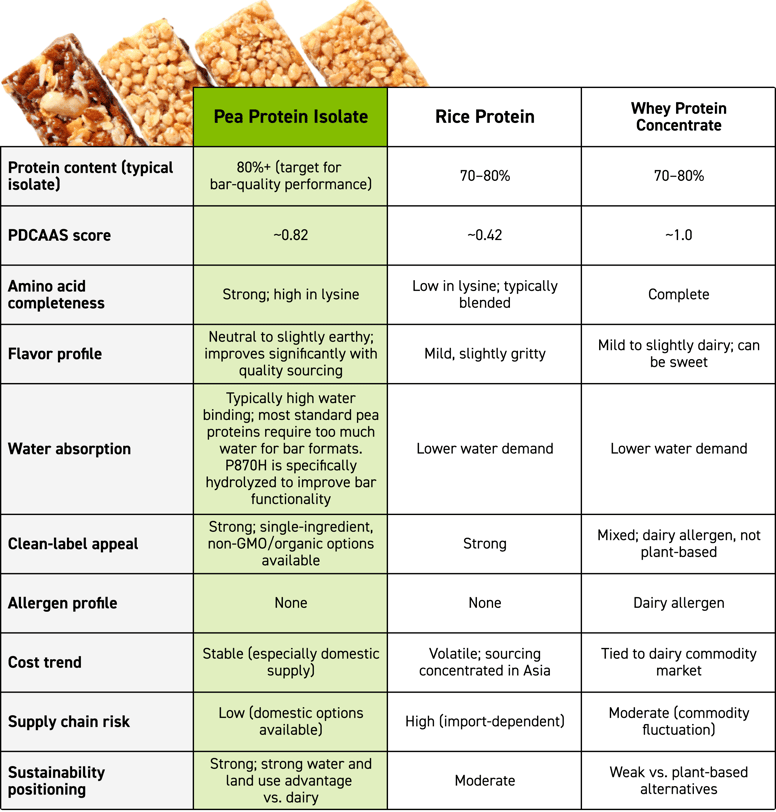
For brands that need high protein purity, allergen-free status, and a clean label, pea protein is the clearest choice. For brands with a non-GMO or plant-based positioning, it's also the most defensible.
For a deeper look at how pea protein compares to whey across applications, see our Plant-Based Protein vs. Whey comparison.
What to look for in a pea protein for bar manufacturing
Not all pea proteins perform the same way in a bar matrix.
Protein content Target 80%+ (dry basis) for bar applications. Lower-purity concentrates require higher inclusion rates to hit protein claims, which increases cost and can compromise texture.
Particle size and dispersibility Coarser particles cause uneven distribution in dry blending. Ask for particle size data and confirm lot-to-lot consistency before committing.
Water absorption rate Pea protein's high water absorption is a binding advantage. Make sure your supplier can provide functional data, not just proximate analysis.
Heavy metal testing Protein concentrates from overseas sources have come under scrutiny for lead and cadmium. Batch-level heavy metal testing should be a standard deliverable from any supplier you work with.
Origin and traceability Where your protein was grown and processed matters for both brand positioning and supply reliability. Domestic sourcing from a vertically integrated supplier gives you lot-to-lot consistency that import alternatives typically cannot.
PURIS® Pea Protein 870H is built for high-protein bar and snack applications. It delivers 80% protein content, neutral flavor, and strong binding behavior in both cold-process and baked formats. Grown and processed entirely in the United States.
Frequently asked questions about protein bar manufacturing
What protein percentage should a protein bar have? Most performance-positioned protein bars target 15–25g of protein per serving (typically a 40–70g bar). Achieving those numbers cleanly, without a long binder or filler ingredient list, requires a high-purity protein isolate at 80% protein content. Lower-purity options require higher inclusion rates, which drive up cost and can soften the bar's texture.
Is pea protein good for protein bars? Yes. Pea protein isolate has become one of the most widely used protein sources in bar manufacturing because of its neutral flavor (when properly processed), high protein content, allergen-free status, and binding behavior in bar matrices. Quality varies significantly by supplier. Processing method, raw material genetics, and lot-to-lot consistency all affect in-formula performance.
What is the difference between pea protein isolate and pea protein concentrate? Pea protein isolate typically contains 80–90% protein on a dry basis and undergoes additional processing to remove starches and fibers. PURIS produces pea protein isolate at 80–90% protein — and nothing below that threshold. Pea protein concentrate contains 55–70% protein and retains more of the natural fiber and starch content. For bar applications where protein density and label simplicity are priorities, isolate is the standard choice.
How do you prevent protein bars from getting too hard? Bar hardness is primarily controlled by water activity and binder ratio. If a bar is hardening during shelf life, the most common causes are insufficient humectant, a protein with poor water retention, or packaging that allows moisture migration. Adjusting the binder system and confirming water activity (target: 0.55–0.65 Aw for most soft bars) usually resolves the issue.
What are the biggest formulation risks when switching protein suppliers? Lot-to-lot consistency is the primary risk. Different suppliers, or even different production runs from the same supplier, can vary in particle size, water absorption, flavor, and functional behavior. Before switching, obtain multiple lots for trial runs and request full COA documentation including proximate analysis, heavy metal testing, and particle size data. Domestic suppliers with vertical integration tend to deliver more consistent raw material because they control the full chain from seed genetics through processing.
Protein bar manufacturing comes down to precision: in your ingredients, your process, and your supplier relationships. The protein you choose is a supply chain decision as much as a nutritional one.
Explore PURIS® Pea Protein 870H. Built for high-protein bar and snack applications, grown and processed in North America.