If you're in food or beverage manufacturing, you've felt the shift. Ultra-processed foods (UPFs) are dominating consumer conversations, Google searches have exploded, and more than 6 in 10 Americans say they're actively trying to avoid UPFs at least some of the time.
As a result, your R&D teams are fielding questions. Your marketing departments are navigating new claims. And your executives are probably wondering: what does this mean for our portfolio?
Here's the challenge: We don't actually have a clear, agreed-upon definition of what ultra-processed food really means. And that's creating both risk and opportunity for manufacturers willing to lead.
The NOVA System: Why It Doesn't ALWAYS Work for Product Development
When consumers talk about ultra-processed foods, they're usually referencing the NOVA classification system developed in 2009 by researchers at the University of São Paulo. NOVA categorizes foods into four groups, with Group 4 being labeled as "ultra-processed."
But here's what product developers need to understand: NOVA was designed to study dietary patterns across populations, not to evaluate individual products.
The implications are significant:
- White bread from a bakery = "processed"
- The exact same formulation from a supermarket = "ultra-processed"
- Oil and sugar = "culinary ingredients" when consumers buy them, but markers of UPF when you use them
"The perception can be that ‘junk food’ and ultra-processed foods are equivalent,” said Julia Wolfson, PhD, MPP, associate professor in the Bloomberg School’s Department of International Health, in a recent study. “Yet ultra-processed foods encompass many more products than just junk food or fast food, including most of the foods in the grocery store."
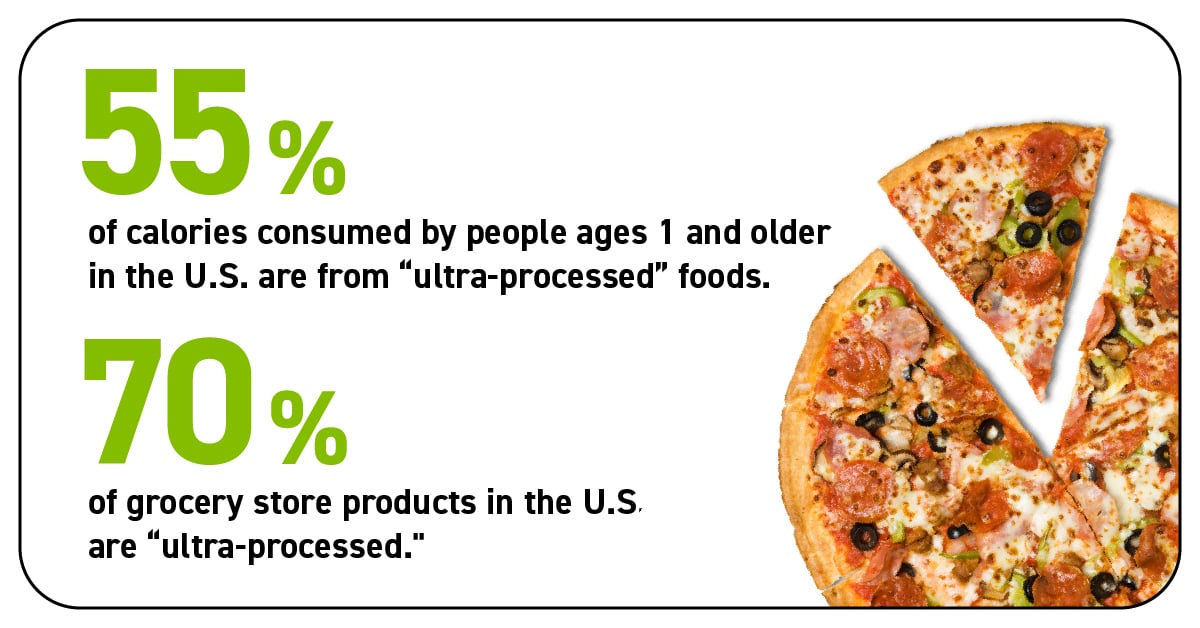
Source: Yale School of Public Health
Even nutrition specialists struggle to consistently categorize foods using NOVA criteria when given the same ingredient information. If the experts can't agree, how can you reformulate with confidence? How can you communicate meaningfully with consumers?
This definitional gap is precisely why brands are struggling to respond to consumer demand — and why there's a massive opportunity for manufacturers who help bring clarity to the conversation.
The Health Research We Can't Ignore
Despite the classification challenges, the health data demands attention from a risk management perspective. A 2024 umbrella review in the British Medical Journal examined 45 studies covering 10 million participants, and found UPF consumption linked to 32 adverse health conditions — including increased mortality, cardiovascular disease, type 2 diabetes, and mental health disorders. The research shows a dose-response relationship: more UPF consumption correlates with worse health outcomes.

For manufacturers, this means the reputation of processed foods is shifting. Today's consumers have concerns in five key areas:
- Hyper-palatability and overconsumption, or products engineered for maximum cravings, are increasingly under scrutiny.
- Nutrient imbalance, including highly refined carbs and unhealthy fats with low fiber or protein content.
- Excessive processing that breaks down the food matrix and reduces the bioavailability of nutrients.
- Isolated and artificial ingredients including additives that have never had FDA review through the GRAS loophole.
- Gut microbiome disruption from certain emulsifiers and artificial sweeteners.
But here's the critical context: 57% of American adults' calories (and 67% of children's daily calories) come from ultra-processed foods. Cost and convenience are the top purchase drivers, with cost being the primary consideration for lower-income households and convenience being the leading factor for higher-income shoppers.
Your consumers aren't going to stop buying packaged foods. They want packaged foods they can trust and feel good about. And in that, there is opportunity.
What Reformulation Actually Looks Like
Here's where manufacturers often get stuck: they know consumers want "less processed" foods, but without clear standards, how do you reformulate? What changes actually matter?
The biggest hurdles manufacturers face:
- No consensus definition to guide R&D decisions
- Conflicting classification systems (NOVA, IFIC, IARC, UNC all use different criteria)
- Functionality challenges when removing certain ingredients
- Cost implications of alternative ingredients
- Shelf life and safety considerations
- Consumer acceptance of taste and texture changes
The good news? Research shows it's possible to create nutritious products even with processing. A USDA study designed a seven-day diet where 91% of calories came from ultra-processed foods that met or exceeded nutritional requirements for most nutrients, scoring an 86 on the Healthy Eating Index.
The takeaway isn't that processing is fine. Rather, it's that nutrient density matters more than processing level alone. Your reformulation strategy should prioritize both.
What To Consider As You Formulate (or Reformulate) Ultra-processed Foods
30% of global food and beverage launches featured a clean-label claim in the past year. Instead of trying to eliminate all processing, focus on these principles that align with emerging consumer expectations.

Prioritize recognizable ingredients: Consumers should be able to decipher the ingredients in your product without needing multiple Google searches.
Eliminate questionable additives: Start with ingredients banned in the EU or flagged by major retailers.
Preserve the food matrix: Choose processing methods that maintain nutrient bioavailability.
Enhance nutrient density: Processing should add value, not just shelf life.
Be transparent about functionality: If an ingredient serves a purpose but is not immediately identifiable by the everyday consumer, explain it clearly.
The Balanced Message Your Customers Need
Here's what the research makes clear: Eliminating all processed foods isn't just unrealistic — it doesn't help consumers. Your communication strategy should acknowledge:
- Processing enables access — Mass food production feeds millions.
- Some processing adds value — Fortification has great benefits to many consumer groups.
- Convenience is legitimate — Realistic food choices are the end goal for most consumers.
- Budget constraints are real — Premium "clean label" products aren't accessible to everyone (and aren't always "better for you").
The most effective approach? Focus on what you're adding (nutrients, whole ingredients, transparency) rather than defending what you're not removing.
The Regulatory and Certification Landscape
The definitional vacuum won't last forever. Standards are being developed right now that will shape how UPF is understood and regulated:
- Non-GMO Project is launching a Non-UPF Verified Certification
- State-level regulations are emerging (California's additive bans are just the beginning)
- Retailer standards are tightening (Whole Foods' banned ingredient list influences the market beyond their stores)
- International precedent from EU regulations creates consumer expectations
The question isn't whether standards will emerge — it's whether you'll help shape them or react to them. Early movers have the advantage. Brands that engage now in developing meaningful, achievable standards will be positioned to lead rather than scramble.
What Can You Do Right Now?
The manufacturers who will thrive through this shift are those who:
- Engage proactively with standard-setting organizations rather than waiting for regulations.
- Invest in reformulation that genuinely improves nutrient density, not just perception.
- Communicate transparently about ingredient choices and their purposes.
- Segment thoughtfully - Not every product needs to be "non-UPF," but your portfolio should include options.
- Partner with retailers who are ahead of the curve on these issues.
- Educate without being defensive - Help consumers understand nuance.
The conversation about ultra-processed food isn't going away. Consumer concern is legitimate, health research is compelling, and regulatory momentum is building.
But the path forward isn't about vilifying all food manufacturing. It's about making the packaged foods that feed millions of people every day work better for human health. The manufacturers who recognize this moment as an opportunity to innovate, lead, and help define what "better" means will be the ones consumers trust and choose.
Want to learn more about the ultra-processed foods market and consumer expectations?